Companies
How Artificial Intelligence Is Reshaping the Future of Business
Not long ago, artificial intelligence (AI) felt like a topic for research labs and science fiction. Today it sits inside the tools that businesses use every day, from customer chatbots to sales forecasts. According to McKinsey’s 2025 global survey, 88 percent of organizations now use AI regularly in at least one business function, up from 78 percent a year earlier. That is a remarkable shift in just a few years. But using AI and benefiting from AI are two very different things. In this article, we explore how AI in business is changing operations, customer experience, decision-making and jobs, and what leaders and young professionals can do to prepare.
What Is AI in Business?
Artificial intelligence refers to software that can learn from data, recognize patterns, make predictions and, increasingly, create new content. In a business setting, that can mean a model that forecasts demand, a tool that sorts support tickets, or an assistant that drafts emails and reports. Generative AI, the technology behind popular chatbots, produces text, images and code from simple instructions. The newest development is agentic AI, where systems plan and complete multi-step tasks with limited human input. McKinsey found that 62 percent of respondents say their organizations are at least experimenting with AI agents, although no more than 10 percent are scaling them in any single function.
How AI Is Transforming Core Business Functions
AI is not confined to the technology department. It is quietly changing how almost every team works, and the clearest way to see this is function by function.
Customer Service and Marketing
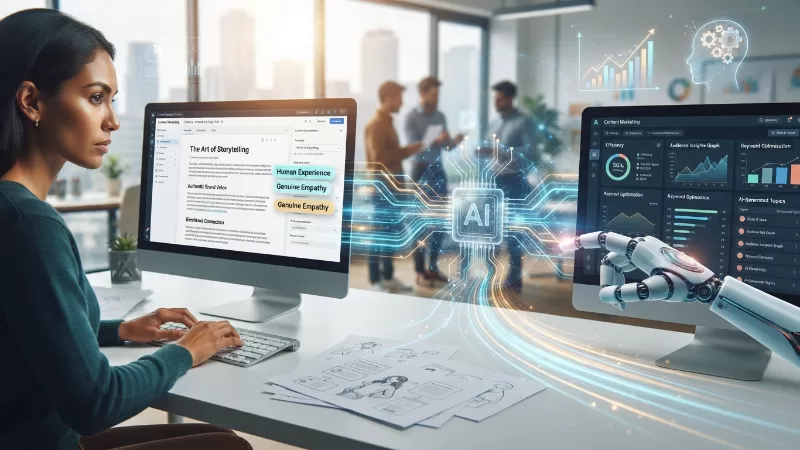
Customer-facing teams were among the first to feel the change. AI chatbots can answer routine questions at any hour, while recommendation engines suggest products based on browsing and purchase history. Marketers use generative AI to draft campaign copy, test headlines and personalize messages for different audiences. The result is faster response times and more relevant communication, but human judgment is still needed to protect brand voice and customer trust.
Operations and Supply Chains
In operations, AI helps companies predict demand, plan inventory and spot equipment problems before they cause costly breakdowns. Logistics teams use it to choose efficient delivery routes, and manufacturers use computer vision to catch defects on production lines. These applications turn large amounts of operational data into practical decisions, reducing waste and improving reliability.
Finance, HR and Decision-Making
Finance teams use AI to detect unusual transactions, automate invoice processing and improve forecasts. Human resources teams use it to screen applications and answer employee questions, although these uses demand careful oversight to avoid bias. Across the organization, AI-powered analytics let managers ask questions of their data in plain language, so decisions rely less on guesswork and more on evidence.
The Adoption Gap: Everyone Uses AI, Few Scale It
Despite the excitement, most companies are still early in their AI journey. McKinsey's survey of 1,993 participants across 105 countries found that only 7 percent say AI has been fully scaled across their organizations. Around 39 percent report any enterprise-level profit impact from AI, and most of those say it is below 5 percent of earnings before interest and taxes (EBIT). Only about 6 percent qualify as “AI high performers,” meaning they attribute 5 percent or more of EBIT to AI. In short, nearly nine in ten organizations use AI, yet fewer than four in ten can point to a measurable financial result.

What separates the leaders from everyone else? According to McKinsey, high performers are 2.8 times more likely to have fundamentally redesigned their workflows, at 55 percent versus 20 percent of other organizations. In other words, bolting a chatbot onto an old process rarely works. Value appears when companies rethink how work gets done and use AI to pursue growth and innovation, not only cost cutting.
AI and the Future of Work
No conversation about AI in business is complete without the question of jobs. The World Economic Forum’s Future of Jobs Report 2025, based on a survey of more than 1,000 employers across 55 economies, projects that 170 million new roles will be created globally by 2030 while 92 million are displaced, a net gain of 78 million. Eighty-six percent of employers expect AI and information processing technologies to transform their business by the end of the decade. The fastest-growing roles include big data specialists, FinTech engineers, and AI and machine learning specialists.
These numbers describe churn, not collapse. Some roles shrink, others grow, and many simply change shape. Expectations inside companies are mixed: in McKinsey’s survey, 32 percent of respondents expect their workforce to shrink in the coming year, 43 percent expect no change and 13 percent expect growth. The biggest obstacle is skills. Sixty-three percent of employers cite skill gaps as a key barrier to business transformation, which makes learning the most valuable response for both companies and individuals.
Risks and Responsible Use of AI
AI also brings real risks. McKinsey reports that 51 percent of respondents have experienced at least one negative consequence from AI. Inaccuracy was the most common at 30 percent, followed by cybersecurity concerns at 10 percent and regulatory compliance issues at 8 percent. Generative AI can produce confident but wrong answers, so important outputs should always be checked by a person. Businesses also need clear rules on data privacy, bias and transparency, especially when AI influences decisions about hiring, pricing or lending.
How Businesses Can Get Started with AI
The research points to a practical roadmap that works for a startup as well as a large company.
Start with a Clear Business Problem
Begin with a specific problem, such as slow customer replies or inaccurate stock forecasts, rather than with a tool. A focused goal makes it easier to choose the right solution and to judge whether it worked.
Redesign Workflows, Not Just Add Tools
Map the existing process, decide which steps AI should handle and which need human judgment, and rebuild the workflow around that split. This is the habit that separates high performers from the rest.
Invest in People and Skills
Train employees to use AI tools, question their outputs and combine them with their own expertise. Skills in data literacy, critical thinking and creativity become more valuable as routine tasks are automated.
Measure Results and Manage Risk
Track business measures such as response time, cost per task, conversion rate and profit impact, and add human review wherever errors would be costly. What is not measured rarely scales.
Conclusion: The Future Belongs to Prepared Businesses
Artificial intelligence is no longer a distant promise. It is already reshaping customer service, operations, finance and the very nature of work. Yet the data shows that using AI is only the starting line; the real rewards go to organizations that redesign their workflows, build skills and manage risks with care. For business owners, the message is to start small, learn fast and measure honestly. For students and young professionals, it is to treat AI as a partner to master, not a threat to fear. The businesses and people who prepare today will be the ones who shape tomorrow.
References
McKinsey & Company (2025). The state of AI in 2025: Agents, innovation, and transformation. https://www.mckinsey.com/mgi/our-research/the-state-of-ai-2025
McKinsey & Company (2025). AI at work but not at scale (chart). https://www.mckinsey.com/featured-insights/charts/ai-at-work-but-not-at-scale
World Economic Forum (2025). The Future of Jobs Report 2025, Chapter 2: Jobs outlook. https://www.weforum.org/publications/the-future-of-jobs-report-2025/in-full/2-jobs-outlook/
ollect information about sales, customers, stock linstance, might use demand

Written by
Sonia Akter
Comments (0)
No comments yet — be the first to share your thoughts.