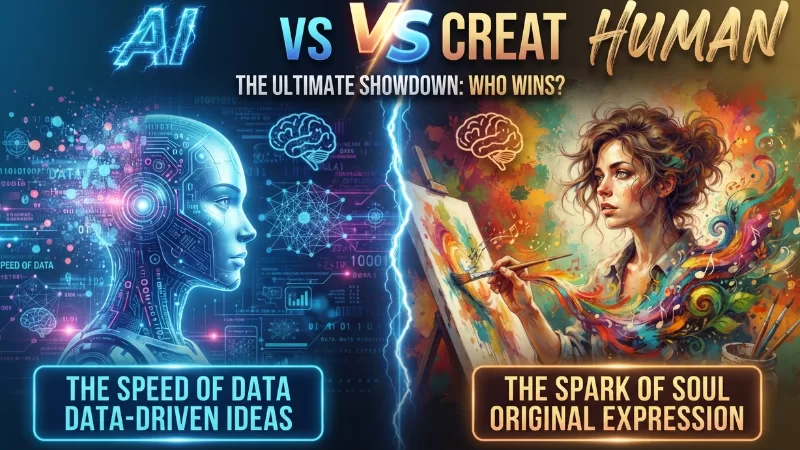
Artificial intelligence can help businesses write their own posts and analyze their customers’ data. It can also develop campaign ideas in minutes.
So the question for us is whether technology can replace human imagination or not. AI vs Human Creativity: Who Wins the Future of Content Marketing Does matter because of AI’s speed. But people can bring experiences, empathy, cultural understanding, and original perspectives that AI can't provide.
What Is AI in Content Marketing?
Artificial intelligence (AI) in content marketing refers to the use of AI-powered software and digital tools to create, analyze, personalize, and improve different types of marketing materials. Over the past few years, AI has become an important part of digital marketing because it helps businesses complete various tasks more quickly and efficiently. The discussion of AI vs Human Creativity: Who Wins the Future of Content Marketing has become increasingly relevant as businesses explore how artificial intelligence can improve their marketing strategies. Instead of doing everything manually, marketers can now use AI tools to generate ideas, organize information, understand customer interests, and develop content for different online platforms.
Some popular AI tools used in content marketing include ChatGPT, Google Gemini, Jasper, and Canva. Each of these tools offers different features that can support marketers throughout the content creation process. One of the most common uses of AI in content marketing is brainstorming.
Sometimes, content creators struggle to find fresh ideas or decide what topics would attract their target audience. AI tools can make this process easier by suggesting blog topics, campaign angles, social media ideas, catchy headlines, and creative approaches. For example, a marketer who wants to promote a new product can use AI to explore different advertising concepts or develop ideas for a social media campaign. This demonstrates one important aspect of AI vs Human Creativity: Who Wins the Future of Content Marketing, where AI provides creative suggestions while humans decide how to use them effectively.
This does not mean that AI makes all the creative decisions. Rather, it provides suggestions that marketers can develop further based on their own understanding and experience. AI can also be useful when preparing written content. It can generate outlines, suggest introductions, write draft captions, summarize lengthy research materials, and help organize information into a clearer structure. These features are particularly helpful for businesses that need to publish content regularly across multiple platforms. For example, a single marketing message can be adapted into different formats for Facebook, Instagram, websites, and email newsletters. This saves time and helps businesses maintain a more consistent communication strategy.
Another important role of AI is supporting keyword research and content optimization. Marketers need to understand what their potential customers are searching for before creating website content or blog posts. AI-powered tools can suggest relevant keywords, identify possible audience questions, and help organize topics according to customer interests. Some tools can also assist with creating draft visuals and promotional designs, making the overall marketing process more convenient. As a result, even smaller businesses with limited marketing resources can explore creative ideas and produce content without spending too much time on every individual task. These developments further explain AI vs Human Creativity: Who Wins the Future of Content Marketing, as AI makes content production more efficient and accessible.
- What Is AI in Content Marketing?
- Why Human Creativity Still Matters
- AI vs Human Creativity: Key Differences
- What Research Says About AI and Creativity
- The Benefits and Limitations of AI
- The Future: Human-AI Collaboration
- Skills Content Marketers Should Develop
- Conclusion: Who Wins?
- FAQ
- Frequently Asked Questions (FAQs)
- 1. Can AI replace content writers?
- 2. Is AI-generated content good for SEO?
- 3. What is the best way to use AI in marketing?
- 4. What is AI in content marketing?
- 5. What are some popular AI tools used in content marketing?
- 6. Is human-written content better than AI-generated content?
- 7. Will AI reduce job opportunities for content writers?
However, using AI does not mean that every output is automatically suitable for publication. Sometimes, AI-generated information may contain factual errors, outdated details, or general statements that do not properly represent a particular business or its audience. The content may also lack originality or the emotional connection that readers expect from a brand. This is where human creativity and judgment become essential. Therefore, human review is necessary before publishing anything.
Marketers should check the accuracy of information, improve the wording, add relevant examples, and make sure the final content reflects the brand's identity. Ultimately, AI vs Human Creativity: Who Wins the Future of Content Marketing is about finding the right balance between technological efficiency and human originality. AI can simplify the content creation process, but human involvement ensures that the final result remains meaningful, authentic, and valuable to the audience.
This discussion is closely connected to the topic "AI vs Human Creativity: Who Wins the Future of Content Marketing?" AI can make content production faster and easier, but human creativity remains important for understanding emotions, experiences, and audience expectations. Rather than depending completely on one or the other, marketers can achieve better results by combining the efficiency of AI with human ideas, judgment, and originality.
Why Human Creativity Still Matters
Human creativity is one of the most valuable elements of content marketing because it comes from personal experiences, emotions, judgments, imagination, and an understanding of different situations. Unlike artificial intelligence, humans do not depend only on previously learned information to develop creative ideas. They can connect their personal experiences with real-life situations and understand how people feel about certain products, services, or brands.
This is an important part of the discussion around AI vs Human Creativity: Who Wins the Future of Content Marketing, as it explains why human involvement is still necessary even when businesses have access to advanced AI tools. One of the biggest strengths of human creativity is the ability to understand emotions and cultural differences. A human marketer can recognize local expressions, understand cultural references, and identify what might make a particular audience happy, disappointed, or interested. They can also understand customers' frustrations and preferences by observing their behavior and listening to their opinions.
AI can analyze customer feedback and suggest possible responses, but it may not fully understand the feelings behind those comments. Similarly, human writers can share meaningful personal stories that create emotional connections with readers. These natural connections are difficult for AI to reproduce because it does not have real-life experiences or personal memories. This highlights an important aspect of AI vs Human Creativity: Who Wins the Future of Content Marketing, as emotional understanding remains one of the key strengths of human writers. For example, consider a clothing store in Bangladesh that wants to promote its products during the Eid season.
An AI tool can easily generate attractive promotional captions, suggest advertising ideas, and create draft campaign messages. However, a local human marketer understands the cultural importance of Eid and knows how customers usually prepare for the occasion. They can decide which words, images, colors, and promotional offers would be appropriate for the local audience. They also understand whether a particular message sounds natural in Bangla or whether it needs a more familiar and culturally relevant expression. This demonstrates why AI vs Human Creativity: Who Wins the Future of Content Marketing is an important discussion for businesses targeting specific cultural audiences.
This example clearly shows the difference between generating content and understanding the people who will actually receive it. Human creativity is particularly important in brand storytelling. Customers often remember a brand not simply because of its products but because of the emotions, experiences, and values connected to it. A creative marketer can develop stories that make people feel connected to a brand. Emotional advertising campaigns, original concepts, and culturally meaningful messages also require careful human judgment. Ultimately, AI vs Human Creativity: Who Wins the Future of Content Marketing highlights that while AI can support content creation, human creativity gives marketing messages their emotional depth, cultural relevance, and authenticity.
These elements help businesses develop a recognizable brand personality and build long-term relationships with customers. Another important responsibility of human marketers is making strategic decisions. AI can provide suggestions based on data, but deciding which direction is suitable for a business requires an understanding of its goals, audience, competition, and identity. Human marketers can evaluate whether a campaign communicates the right message and whether it matches the expectations of customers. This is another reason why AI vs Human Creativity: Who Wins the Future of Content Marketing is an important discussion for modern businesses. Ultimately, human creativity is not becoming less valuable because of AI. Instead, its importance is becoming more noticeable.
AI can support content production, but humans provide the emotional understanding, cultural awareness, originality, and judgment that make content meaningful. The real future of content marketing will depend on using technology without losing the human connection. AI vs Human Creativity: Who Wins the Future of Content Marketing reminds us that successful marketing is not only about producing content quickly; it is also about creating something that people can understand, trust, and remember.

Just like for a Bangladeshi clothing store, AI can draft a promotion but a local marketer judges whether it fits the season, language and culture or not.
Our human creativity is especially valuable for brand storytelling, emotional campaigns, cultural nuance, original concepts, strategic decisions, and building trust.
AI vs Human Creativity: Who Wins the Future of Content Marketing highlights why people remain responsible for meaningful thoughts, contexts, and judgments.
AI vs Human Creativity: Key Differences
Area AI HumansSpeed Produces drafts quickly Usually needs more timeData Analysis Processes large data sets Interrupts contacts and implicationsEmotional insight Can imitate emotion languageDraws on genuine experienceConsistency Follows repeatable instructionsStyle can varyOriginality Combines learned patterns Can create from new experiencesScale Supports high-volume productionRequires more time and resources
In AI vs Human Creativity: Who Wins the Future of Content Marketing, the best choice can depend on the audience, task, and goal.

What Research Says About AI and Creativity
Research helps us to explain AI vs Human Creativity: Who Wins the Future of Content Marketing It shows us that generative AI can be useful when it is applied carefully.
A 2025 International Journal of Research in Marketing study, “The Power of Generative Marketing,” found that AI created marketing images which could score strongly for aesthetics and realism such as human can. For that AI kind of image quality it does not guarantee campaign success for us.
A 2025 Journal of Business Research study by Colleen P. Kirk and Julian Givi found that consumers may respond less positively or seriously to emotional messages they believe are AI-written. The effect was weaker for factual communication or AI-assisted editing.
Content Marketing Institute’s 2025 B2B Research reported that fewer tedious tasks and more efficient workflows among these marketers are using Generative AI for their work. Overall, AI can improve production but human judgment supports trust and relevance.
The Benefits and Limitations of AI
Artificial intelligence (AI) is becoming an important part of the content marketing industry. It has changed the way businesses plan, create, and manage their content. The topic of AI vs Human Creativity: Who Wins the Future of Content Marketing highlights how AI is transforming traditional marketing practices while creating new opportunities for businesses. One of the biggest advantages of AI is its speed. Tasks that might take hours for a human writer, such as brainstorming ideas, organizing information, or analyzing audience interests, can often be completed within a few minutes using AI tools.
This makes AI especially useful for small businesses and marketing teams that have limited time, resources, or budgets. It can also help marketers develop campaign ideas, suggest attractive headlines, create social media captions, and explore different approaches to reach their target audiences. Another major strength of AI is its ability to work with large amounts of data. Content marketers often need to understand customer behavior, identify market trends, and discover what people are searching for online. AI can help analyze this information, summarize research findings, and identify common questions or interests among potential customers. It can also support content calendar planning by suggesting topics for different platforms and helping marketing teams maintain a consistent publishing schedule.
In this way, AI works as a useful assistant that allows marketers to focus more on planning, creativity, and decision-making rather than spending all their time on repetitive tasks. This is an important part of understanding AI vs Human Creativity: Who Wins the Future of Content Marketing, as both AI and humans bring different strengths to the content creation process. Despite these benefits, AI also has several limitations that cannot be ignored. The most important difference between AI and human creativity is personal experience.
Human writers can express real emotions, share personal stories, and understand situations based on their own experiences. AI, on the other hand, generates content by identifying patterns in the information it has learned. As a result, its writing may sometimes sound unnatural or lack the emotional connection that makes content meaningful to readers. It can also misunderstand cultural differences, local expressions, humor, or sensitive topics. Another serious concern is accuracy.
AI sometimes produces information that sounds convincing but is actually incorrect or completely made up. If marketers publish such information without checking it, they may lose the trust of their audience. These limitations are an important consideration in AI vs Human Creativity: Who Wins the Future of Content Marketing, because technology cannot completely replace human understanding and judgment.
Overusing AI can also create another problem: repetitive and predictable content. When businesses depend entirely on AI-generated writing, their blogs, advertisements, and social media posts may start sounding similar. This makes it difficult for a brand to develop a unique identity.
Therefore, human involvement remains essential. Editors and content creators should carefully verify facts, check reliable sources, protect confidential information, and make sure that every piece of content reflects the brand's personality and values. Google's guidance also highlights that generative AI can be helpful for research, planning, and developing content structures. However, the main priority should always be creating original, accurate, and valuable content for people. Publishing large numbers of low-quality pages mainly to manipulate search rankings may violate Google's spam policies. This clearly shows that AI-generated content is not automatically SEO-friendly. Its quality and usefulness matter much more than the tool used to create it.
Ultimately, the future of content marketing is unlikely to be a competition in which AI completely replaces humans. Instead, the strongest results will come from combining AI's efficiency with human creativity, experience, and judgment. AI vs Human Creativity: Who Wins the Future of Content Marketing is ultimately about finding the right balance between technological efficiency and human originality. Businesses that understand this balance will be better positioned to create valuable, engaging, and authentic content for their audiences.
AI vs Human Creativity: Who Wins the Future of Content Marketing is not simply about choosing one over the other; it is about understanding how both can work together to achieve better results. AI can make the process faster, but humans give content its personality, emotion, and authenticity. The real winner of the future will be the marketer who knows how to use AI effectively without losing the human touch.

The Future: Human-AI Collaboration
The strongest answer to AI vs Human Creativity: Who Wins the Future of Content Marketing is collaboration: AI can assist us with repetitive tasks while people lead strategy, originality and quality control.
For example a clothing store's summer launch, AI Can summarize search trends, suggest topics, draft captions and analyze results. On the other hand a human marketer chooses the campaign idea, defines the tone, checks culture fit and accuracy, and decides what to improve. This saves us some time without surrendering the brand's identity.
Skills Content Marketers Should Develop
AI vs Human Creativity: Who Wins the Future of Content Marketing Also can change the skills that marketers need. Marketers should strengthen complementary skills like writing and storytelling for a distinctive voice; seo fundamentals to understand the search intents; research and fact checking to verify claims; AI literacy is to access tools outputs; and strategy and analytics to connect content with business outcomes.

Conclusion: Who Wins?
AI excels at speed, automation, data patterns and repetitive works but humans contribute empathy, cultural awareness, judgment and accountability for these contents. AI vs Human Creativity: Who Wins the Future of Content Marketing Is about the partnership not about the replacement. Businesses who are combining AI efficiency with human originality can create relevant and trustworthy content.
FAQ
Frequently Asked Questions (FAQs)
1. Can AI replace content writers?
Ans: In the discussion of AI vs Human Creativity: Who Wins the Future of Content Marketing, AI can assist with drafts and routine writing tasks, but human writers remain important for research, originality, tone, emotional connection, and creative judgment.
2. Is AI-generated content good for SEO?
Ans: When discussing AI vs Human Creativity: Who Wins the Future of Content Marketing, AI-generated content can perform well in SEO when it is useful, accurate, original, and created for people. However, using AI alone cannot guarantee higher search rankings.
3. What is the best way to use AI in marketing?
Ans: The best approach to AI vs Human Creativity: Who Wins the Future of Content Marketing is to use AI for research support, content outlines, repetitive tasks, and draft variations while keeping humans responsible for strategy, creativity, editing, and final decisions.
4. What is AI in content marketing?
Ans: In AI vs Human Creativity: Who Wins the Future of Content Marketing, AI in content marketing refers to using artificial intelligence tools and software to create, analyze, personalize, and optimize marketing content. It helps marketers with brainstorming, writing, keyword research, designing, and campaign planning.
5. What are some popular AI tools used in content marketing?
Ans: Several popular tools discussed in AI vs Human Creativity: Who Wins the Future of Content Marketing include ChatGPT, Google Gemini, Jasper, and Canva. These tools help marketers generate ideas, write content, create visuals, research keywords, and plan campaigns.
6. Is human-written content better than AI-generated content?
Ans: In the context of AI vs Human Creativity: Who Wins the Future of Content Marketing, neither is always better. Human-written content often offers personal experiences, emotional connections, and originality, while AI-generated content provides speed and efficiency. Overall quality depends on relevance, accuracy, creativity, and usefulness.
7. Will AI reduce job opportunities for content writers?
Ans: AI vs Human Creativity: Who Wins the Future of Content Marketing also raises concerns about employment opportunities. AI may change the responsibilities of content writers and automate some repetitive tasks. However, skills such as storytelling, editing, creative thinking, research, and strategic communication will remain important.
Written by
Rashed Anower Ratul
Comments (0)
No comments yet — be the first to share your thoughts.