Introduction
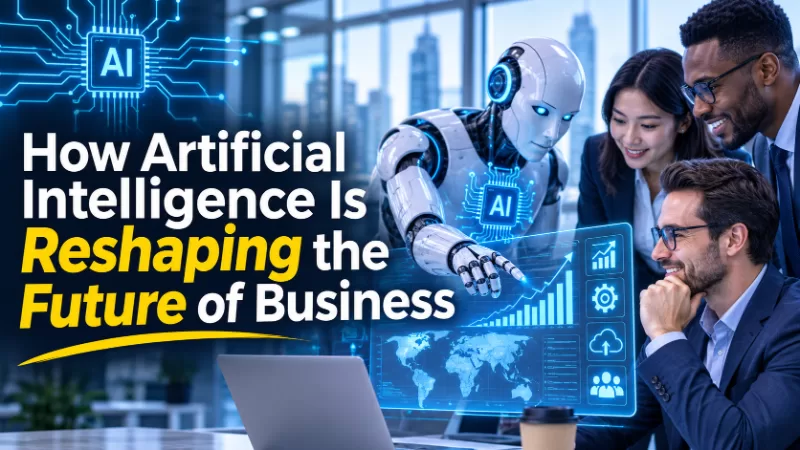
The global business landscape is undergoing its most profound transformation since the dawn of the internet. Artificial Intelligence (AI) is no longer a distant futuristic concept confined to tech giants; it has become the central nervous system of modern enterprise. From local startups to multinational corporations, businesses are rapidly integrating intelligent algorithms into their daily operations to drive growth, optimize workflows, and unlock unprecedented levels of efficiency. Understanding how AI is reshaping commerce is essential for any organization aiming to survive and thrive in the coming decade.
1. Hyper-Automation and Operational Excellence

For decades, businesses relied on manual labor to execute repetitive administrative tasks. Today, intelligent automation—combining AI with Robotic Process Automation (RPA)—is revolutionizing operational efficiency.
· Streamlining Workflows: Modern enterprises deploy AI systems to manage complex supply chains, automate invoice processing, and handle real-time inventory tracking with near-zero error rates.
· Empowering Human Capital: Rather than merely replacing jobs, automation liberates employees from mundane, repetitive duties. This shift allows human talent to focus on high-level strategic thinking, creative problem-solving, and complex negotiations.
2. Predictive Analytics and Data-Driven Decision Making
Every day, businesses generate massive volumes of raw data. Historically, analyzing this information required weeks of manual effort, often resulting in delayed decisions. AI algorithms process terabytes of structured and unstructured data in milliseconds, turning raw numbers into actionable intelligence.
- Forecasting Market Shifts: Machine learning models analyze historical sales, seasonal fluctuations, and global economic indicators to predict future consumer demand accurately.
- Proactive Risk Mitigation: In sectors like finance and logistics, AI continuously monitors transactions and operations to detect anomalies, prevent fraudulent activities, and identify potential supply chain bottlenecks before they cause financial damage.
3. Redefining Customer Experience Through Personalization
Modern consumers expect brands to understand their unique preferences instantly. Generic marketing campaigns are rapidly losing effectiveness, making way for AI-powered hyper-personalization.
- Tailored Recommendations: E-commerce platforms and streaming services utilize sophisticated recommendation engines—similar to those pioneered by Amazon and Netflix—to analyze browsing behavior and suggest products tailored to individual tastes.
- 24/7 Intelligent Support: Next-generation conversational AI and virtual assistants handle thousands of customer inquiries simultaneously, offering instant, human-like resolutions across multiple languages without wait times.
4. Accelerating Innovation and Product Development
AI is dramatically compressing the timeline required to bring new products to market. By utilizing generative AI and simulation models, companies can test thousands of design variations virtually before investing in physical prototypes.
- Rapid Prototyping: Manufacturing and pharmaceutical firms use AI-driven simulations to test material durability or predict molecular interactions, slashing research and development (R&D) costs significantly.
- Agile Marketing Content: Marketing teams leverage generative tools to brainstorm campaign concepts, analyze audience sentiment, and optimize digital ad placements in real time.
5. Navigating Ethical Challenges and Governance
While the advantages of AI are transformative, responsible adoption is critical for long-term sustainability. Business leaders must actively address several emerging challenges:
- Data Privacy and Cybersecurity: Handling vast amounts of customer data requires stringent encryption and compliance with global privacy regulations to maintain consumer trust.
- Eliminating Algorithmic Bias: AI models learn from historical data; if that data contains human biases, the system may unintentionally make unfair hiring or lending decisions. Continuous auditing is essential to ensure fairness.
- Workforce Upskilling: To maximize return on AI investments, companies must invest in continuous training programs so employees can effectively collaborate with intelligent tools.
Conclusion
Artificial intelligence has fundamentally altered the rules of business competition. Organizations that view AI merely as a cost-cutting tool will miss its true potential; the real winners will be those who use it to innovate, personalize customer journeys, and make smarter strategic decisions. By balancing cutting-edge technological adoption with strong ethical governance and workforce development, businesses can build a resilient, profitable, and future-ready enterprise.
References
1. McKinsey Global Institute – The State of AI: How Organizations Are Rewiring to Capture Value.
2. Harvard Business Review – Competing in the Age of AI: Strategy and Leadership When Algorithms and Networks Run the World.
3. MIT Sloan Management Review – Artificial Intelligence and Business Strategy: Empirical Insights and Ethical Frameworks.

Written by
Mehedi Hasan Ridom
Student, M SEO 2606
Comments (0)
No comments yet — be the first to share your thoughts.