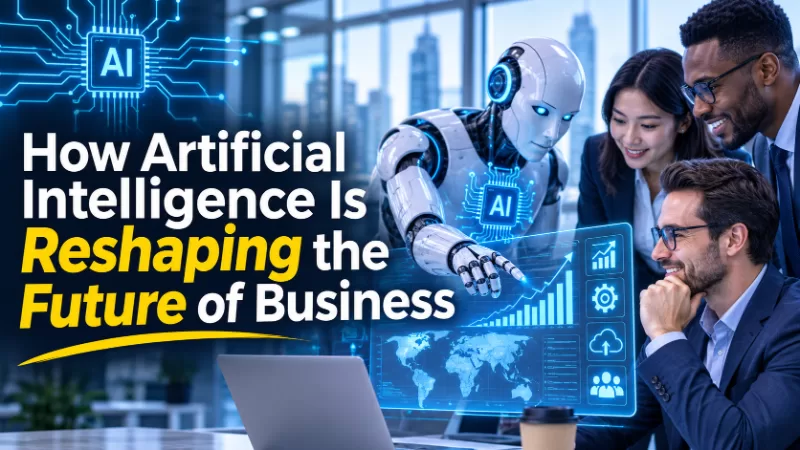
Artificial intelligence (AI) has moved from the margins of business experimentation into everyday work. Companies now use machine-learning systems, generative AI assistants and increasingly capable AI agents to analyze information, support employees and automate parts of complex processes. The shift is not simply about adopting a new tool. It is about redesigning how work gets done, how customers are served and how decisions are made.
The scale of adoption is striking. Stanford University's 2026 AI Index, drawing on enterprise survey data, reports that 88% of surveyed organizations used AI in at least one business function in 2025, compared with 78% in 2024 [1]. Yet widespread use does not guarantee business transformation. The central challenge for leaders is to connect AI capabilities to clear goals, reliable information and accountable people.
1. Smarter operations and more efficient workflows
One of AI's most immediate effects is the automation or acceleration of routine, information-heavy work. Systems can classify documents, summarize long reports, extract details from forms, draft standard communications and route requests to the right team. In manufacturing and logistics, predictive models can help forecast demand, identify equipment problems and improve inventory planning. In finance, AI can support anomaly detection, transaction monitoring and scenario analysis.
Generative AI adds another layer. Instead of only predicting a number or sorting records, it can produce and interpret text, images, code and other content. Staff may use it to prepare a first draft, compare documents, query internal knowledge or generate software tests. AI agents can go further by carrying out sequences of connected tasks, such as gathering information, updating a system and preparing a report. These systems still need carefully defined permissions and human oversight, especially when actions affect customers, money or business-critical records.
The business case should be measured at workflow level, not by counting how many employees have access to a chatbot. Leaders should ask whether a process becomes faster, more accurate, less expensive or easier for customers. They should also check whether new review tasks, errors or technology costs offset the expected savings.
2. A more personal and responsive customer experience
AI is changing how businesses understand and interact with customers. Recommendation engines can tailor products and content to a person's interests. Customer-service assistants can answer common questions at any hour, retrieve information from approved knowledge bases and hand more complicated cases to human staff. Marketing teams can use AI to analyze feedback, identify audience patterns and adapt messages for different customer groups.
The strongest experiences combine speed with relevance and a clear path to human help. A customer may appreciate an instant answer about an order, but will lose confidence if the system invents a policy or cannot resolve an unusual problem. Businesses should make it clear when a customer is interacting with AI, limit the information systems can access, and monitor whether service quality is improving across different groups of users.
3. Better decisions, faster innovation
AI can help decision-makers work with larger volumes of information than they could review manually. Forecasting tools can compare sales trends, seasonality and supply signals. Product teams can summarize research and cluster customer feedback. Analysts can use AI to explore scenarios or identify unusual patterns that deserve investigation. These outputs do not replace strategic judgment; they give people another way to test assumptions and focus their attention.
Recent evidence highlights both the promise and the gap between individual productivity and company-wide returns. In McKinsey's 2026 global survey, 80% of respondents said AI had improved their individual productivity, but only 37% reported a positive contribution to their organization's earnings before interest and taxes (EBIT) [2]. This suggests that personal time savings do not automatically become financial gains. Businesses often need to redesign end-to-end workflows, update roles and incentives, and coordinate data and technology across departments before benefits appear in the results.
4. The workforce is changing - not standing still
AI changes the mix of tasks inside many jobs. It may reduce time spent on repetitive drafting, basic research or routine data handling while increasing the importance of problem framing, communication, judgment, domain expertise and the ability to check machine-generated work. In many roles, the practical future is collaboration: employees use AI for a first pass, then apply context, verify facts and take responsibility for the final decision.
The World Economic Forum's Future of Jobs Report 2025 found that employers expect 39% of workers' existing skills to be transformed or become outdated by 2030, and 85% of surveyed employers planned to prioritize workforce upskilling [3]. Businesses therefore need more than software training. Useful learning includes data literacy, AI tool evaluation, privacy awareness, critical thinking and role-specific practice. Managers also need to explain how AI will affect responsibilities and create routes for employees to raise concerns or suggest improvements.
5. Managing risk, trust and accountability
AI can produce confident but incorrect answers, reproduce bias in training data, expose sensitive information or create security weaknesses. Models may also behave differently as data, prompts or connected tools change. For these reasons, organizations should not treat AI output as automatically accurate or neutral. High-impact decisions - such as hiring, lending, medical support or eligibility assessments - require especially careful legal, ethical and technical review.
A practical governance approach begins with an inventory of AI systems and the business purpose for each one. Teams should classify the sensitivity of the data, test outputs with realistic cases, restrict access, log important actions and assign a named owner. People affected by AI-supported decisions should have an appropriate way to question or appeal them. The US National Institute of Standards and Technology's Generative AI Profile offers a voluntary, cross-sector framework for identifying and managing risks throughout the AI lifecycle [4]. Organizations should combine such guidance with the laws and professional requirements that apply in the markets where they operate.
6. How businesses can turn AI into lasting value
Start with a business problem, not a technology trend
Choose a process where a real problem is visible: long response times, costly manual checks, avoidable errors or slow access to information. Define the desired result before selecting a model or vendor. A narrow use case with clear ownership is usually easier to evaluate than a broad promise to 'use AI everywhere.'
Build the foundations and measure the pilot
Check whether the required data is accurate, permitted for the intended use and available in a secure form. Involve the people who perform the work, agree on human review points and test edge cases. Measure a small set of outcomes - for example, time per task, error rate, customer satisfaction and total cost - against a baseline. Include the costs of integration, training, monitoring and ongoing model use.
Scale what works, and keep improving
If the pilot delivers a reliable benefit, update the workflow, train the wider team and monitor performance after launch. Keep a record of incidents and user feedback, and reassess the system when the model, data or business process changes. Small and medium-sized businesses can start with focused tools or vendor services rather than building a complex AI platform from scratch. OECD analysis identifies connectivity, data, computing resources, skills and finance as important enablers of SME adoption, while noting that smaller firms generally lag larger firms in AI use .
The future belongs to businesses that use AI thoughtfully
Artificial intelligence is reshaping competition by changing the speed and scale at which businesses can process information, serve customers and develop ideas. But buying access to an AI tool is not a strategy. Long-term value comes from choosing the right problems, redesigning workflows, preparing employees, protecting data and measuring results honestly. Organizations that pair capable technology with human judgment and clear accountability will be better placed to adapt as AI continues to evolve.
References
[1] Stanford Institute for Human-Centered Artificial Intelligence. (2026). The 2026 AI Index Report - Economy. Stanford HAI economy chapter
[2] Tinkoff, D., Van der Veken, L., Chui, M., & Balakrishnan, T. (2026, August 25). The state of AI in 2026: On the road to ROI. McKinsey & Company. McKinsey 2026 survey
[3] World Economic Forum. (2025, January 7). The Future of Jobs Report 2025. World Economic Forum report
[4] Autio, C., et al. (2024, July 26). Artificial Intelligence Risk Management Framework: Generative Artificial Intelligence Profile (NIST AI 600-1). National Institute of Standards and Technology. NIST AI 600-1
[5] OECD. (2025, December 9). AI adoption by small and medium-sized enterprises: OECD discussion paper for the G7. OECD Publishing. OECD SME adoption report

Written by
Imam Hossain Zihad
Comments (0)
No comments yet — be the first to share your thoughts.