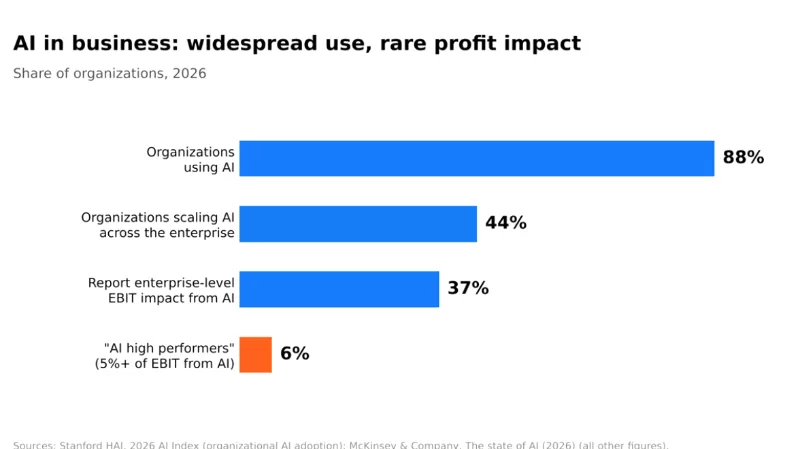
Not long ago, artificial intelligence (AI) was something businesses read about in technology magazines. Today, AI in business answers customer chats, drafts marketing copy, forecasts demand and flags suspicious payments. According to Stanford's 2026 AI Index, 88% of organizations worldwide now use AI.
But using AI is not the same as being transformed by it. McKinsey's latest global survey shows that most companies still struggle to turn experiments into measurable profit. This article explains how AI is changing the way companies operate, hire and compete, and what leaders, including small business owners in Bangladesh, should do next.
What Is AI in Business, and Why Does It Matter Now?
AI in business means using software that learns from data to perform tasks that normally need human judgement, such as understanding language and making predictions. The newest wave, generative AI for business, can also write, summarize and translate, so it is useful far beyond the IT department. Stanford reports record global corporate AI investment of $581.7 billion in 2025, and McKinsey found that 44% of organizations are now scaling AI across the enterprise, up from 38% a year earlier.
Five Ways AI Is Reshaping How Businesses Operate
1. Faster, Smarter Customer Service
AI assistants answer routine questions around the clock, leaving human agents free for complicated cases. A widely cited study of 5,179 support agents found that an AI assistant raised productivity by 14% on average, and by 34% for novice and lower-skilled workers.
2. Personalized Marketing and Sales
McKinsey's 2026 survey reports that revenue gains from AI are most often seen in marketing and sales, where teams use AI to segment audiences, personalize offers and draft campaign copy.
3. More Efficient Operations and Supply Chains
Cost reductions are most often reported in supply chain management, service operations and manufacturing, where AI automation supports demand forecasting and quality inspection. Bangladeshi garment makers are already evaluating AI for production planning, though many projects are still at the evaluation stage.
4. Better Financial Decisions and Risk Management
In finance, AI can strengthen risk assessment and detect fraud. The strongest results come when people treat AI output as one input to a decision, not as the final answer.
5. AI Agents: From Assistants to Digital Coworkers
AI agents can plan and carry out multi-step tasks with limited supervision. McKinsey reports that 40% of large organizations are scaling agents, compared with 22% of smaller ones, while Stanford, using a different survey, finds deployment still in the single digits across most functions. Both agree that agents are early-stage.
The Reality Check: High Adoption, Harder Profits
Using AI does not automatically make a company richer. In McKinsey's 2026 survey, only 37% of respondents report an enterprise-level impact on earnings before interest and taxes (EBIT), essentially unchanged from 2025, and only about 6% qualify as "AI high performers". Real artificial intelligence business transformation happens when companies redesign workflows, set clear goals and train people, rather than simply adding a chatbot to an old process.
AI Jobs and Skills: How Work Is Changing
The World Economic Forum's Future of Jobs Report 2025 projects 170 million new jobs and 92 million displaced by 2030, a net gain of 78 million, and estimates that 59 of every 100 workers will need reskilling or upskilling.
Early evidence is mixed. Stanford's 2026 AI Index shows that headcounts for software developers and customer support agents aged 22 to 25 fell between 2021 and 2025, while most older age groups grew. Learning AI tools early is therefore a real advantage, especially when paired with human skills such as analytical thinking, resilience and collaboration.
What AI Means for Bangladesh: Opportunities and Gaps
Bangladesh has drafted a National AI Policy 2026-2030 proposing a risk-based regulatory framework, AI education from grades 8 and 9, a Bangla-language national AI model and an AI Innovation Fund of Tk 200 to Tk 250 crore through 2030. The draft also warns that automation could threaten up to 60.8% of garment sector jobs, about 2.7 million workers, and the latest reports say it still awaits final adoption.
Small and medium enterprises (SMEs) face the toughest path. A Daily Star commentary notes that they employ 80% of the non-farm workforce, while a garment-industry director quoted by bdnews24 says even small investments eat into working capital. The advice from the Bangladesh AI Business Summit on 5 November 2026 was realistic: solve real factory problems, start with small pilots, prove the results, then seek larger investment.
Risks and Challenges Every Business Should Manage
AI creates value only when its risks are managed. Three challenges stand out:
- Inaccuracy. In McKinsey's early-2024 survey, nearly one-quarter of respondents reported negative consequences from generative AI's inaccuracy, so important outputs need human review.
- Weak governance and legal gaps. Stanford warns that AI is advancing faster than the systems built to govern it, and experts quoted by bdnews24 note that Bangladesh still has no national AI law, so companies need clear internal rules on data privacy and responsible use.
- Skills shortages. The World Economic Forum found that 63% of employers see the skills gap as a main barrier to business transformation.
How to Start Using AI in Your Business: A Practical Roadmap
You do not need a huge budget to begin. A simple approach works for most organizations:
- Pick one real problem. Choose a repetitive, measurable task, such as answering common customer questions.
- Run a small pilot. Test with a small team and compare the results with your current process.
- Prepare data and train people. Clean your records and invest in upskilling.
- Set rules. Decide what data AI tools may use and keep humans in the loop for important decisions.
- Measure and scale. Track time saved or revenue gained, and expand only what works.
Conclusion: The Future Belongs to Businesses That Learn Fastest
Artificial intelligence is reshaping business by changing how companies serve customers, run operations, make decisions and build their workforces. The evidence shows widespread adoption but uneven profits, new jobs alongside displaced ones, and real risks. The future of business with AI will belong to those who pair AI with clear goals, trained people and responsible rules.
For students and young professionals, the message is encouraging: learn AI tools, strengthen the human skills machines cannot copy, start small and keep people at the center of every AI decision.
References
- Stanford Institute for Human-Centered AI (2026). The 2026 AI Index Report: Economy. hai.stanford.edu/ai-index/2026-ai-index-report/economy
- McKinsey & Company (25 August 2026). The state of AI. mckinsey.com/capabilities/quantumblack/our-insights/the-state-of-ai
- McKinsey & Company (2024). The state of AI in early 2024: Gen AI adoption spikes and starts to generate value. mckinsey.com/our-insights/the-state-of-ai-2024
- World Economic Forum (January 2025). Future of Jobs Report 2025: 78 million new job opportunities by 2030 but urgent upskilling needed to prepare workforces. weforum.org press release
- Brynjolfsson, E., Li, D. and Raymond, L. (2023). Generative AI at Work. NBER Working Paper 31161. nber.org/papers/w31161
- The Daily Star (26 January 2026). Draft AI policy targets innovation, better public services. thedailystar.net
- The Financial Express (6 November 2026). Real-life problem solving key to AI adoption in business. thefinancialexpress.com.bd
- bdnews24 (15 January 2026, updated 21 August 2026). Bangladesh faces a critical challenge in preparing for the fourth industrial revolution. bdnews24.com/tech/80e1ace7e38d
- Rahman, M. The Daily Star. Grounded in the AI race (opinion). thedailystar.net
- Tex talks (24 August 2026). Bangladesh steps up AI push as business leaders focus on workforce and industrial transformation. textalks.com
- Your Story (2026). Stanford AI Index 2026: AI is advancing faster than we can manage. yourstory.com

Written by
Md Sajib Saikh
Comments (0)
No comments yet — be the first to share your thoughts.