Quick Answer
AI search SEO means making your content findable and trustworthy beyond Google, in ChatGPT, Perplexity, Gemini and social video too. Google still sends most traffic, but AI answers cut clicks and often cite communities and video. To win, answer questions first, publish original proof, allow the right crawlers and build a visible brand.
Introduction
Think about how you looked for something the last time you needed it. Maybe a tailor, a course or a pitha delivery service in Dhaka. A few years ago you would have typed three words into Google.
Today you might ask ChatGPT, read an AI summary on Google, watch a YouTube review or ask a Facebook group. Four different routes lead to the same decision, and only one of them is a classic search result.
That shift is what AI search SEO is about. My position is simple: Google still matters, but it is no longer the whole game. Below, you will see how these four doors work, what the latest evidence says, how answer engine optimization (AEO) and generative engine optimization (GEO) fit in, and a six-step plan for Bangladeshi businesses.
Why Does "Beyond Google" Matter Now?
Google is still the biggest door, but it is changing
Search is not leaving Google. A study of 101,574 websites found that organic search still made up 42.75% of all website traffic in early 2026 (SE Ranking, 2026). But inside Google, the results page is changing too. Pew Research Center analyzed the browsing data of 900 U.S. adults from March 2025 and found that users clicked a traditional result in 8% of visits when an AI summary appeared, compared with 15% when it did not (Chapekis, 2025).
People now use more than one door
OpenAI said in early 2026 that ChatGPT had about 900 million weekly active users (eWeek, 2026). Google has also added AI Mode, and in October 2025 it announced Bengali among new AI Mode languages in an announcement focused on India (Google India, 2025).
Meanwhile, social platforms act as search engines: an Adobe Express survey found that 65% of Gen Z respondents in the U.S. had used TikTok as a search engine (Southern, 2026a).

I call this the Four Doors framework. It gives you one question to ask about every page you publish: can a customer find and trust me through each door?
- 1. Google results — Where it happens: Classic search. What you win: A click. What it needs: Indexed, helpful, fast pages.
- 2. Google AI features — Where it happens: AI Overviews, AI Mode. What you win: A cited link. What it needs: Clear answers, original value.
- 3. AI assistants — Where it happens: ChatGPT, Gemini, Perplexity, Copilot, Claude. What you win: A named source. What it needs: Crawler access, mentions, trust.
- 4. Social and video — Where it happens: YouTube, Facebook, TikTok. What you win: A trusted mention. What it needs: Useful videos, posts, reviews.
How Do AI Search Tools Choose What to Show?
They break your question into smaller questions
Google describes a method it calls query fan-out: before writing an AI answer, the system turns your one question into many smaller searches on related subtopics (Google Search Central, n.d.).
Other AI tools work in a similar spirit. They search, read several pages and stitch the findings into one reply. For you, that means one paragraph on your page might get picked for a side-question you never planned for.
They cite more than company websites
Ahrefs analyzed more than 3.1 million U.S. queries and tracked which sites Perplexity cites. Reddit led with a 24.6% share of citations among the top 50 sources, followed by YouTube at 14.2% and Wikipedia at 7.2%; Facebook also appeared at 3.1% (Ahrefs, 2026).
The lesson is practical: AI tools often trust community discussion and video, not only brand websites. Your reputation outside your own site now helps your visibility.
Each platform has its own access rule
OpenAI documents a crawler called OAI-SearchBot that is used to surface websites in ChatGPT's search features, and it recommends allowing it in robots.txt. Sites that opt out will not be shown in ChatGPT search answers, though they can still appear as navigational links.
A separate crawler, GPTBot, relates to training, so you can treat the two differently (OpenAI, n.d.).
What Do the Numbers Really Say?
AI traffic is small, but its visitors look engaged
SE Ranking analyzed 101,574 websites from January 2025 to April 2026. AI platforms sent 0.32% of all website traffic, up from 0.24% in 2025 and 0.02% in 2024. ChatGPT supplied 74.78% of that AI traffic, Gemini 11.56%, Perplexity 7.23%, Copilot 3.51% and Claude 2.62%.
In the January to April 2025 engagement data, AI visitors stayed about 9 minutes 19 seconds per session versus 5 minutes 33 seconds for organic visitors (SE Ranking, 2026).
So AI search is still tiny as a traffic source, yet growing fast and sending visitors who stay longer. Brand influence may be bigger than the numbers show, because an AI answer can lead someone to search your name later, and that visit is counted as ordinary search.
Inside Google, fewer clicks on some queries
A 2026 randomized field experiment by researchers at the Indian School of Business and Carnegie Mellon University gave 1,065 U.S. participants either normal Google, Google with AI Overviews hidden, or AI Mode.
Where an AI Overview appeared, outbound organic clicks fell by 38%, while self-reported satisfaction barely changed (Southern, 2026b).
What practitioners are saying
Numbers are only half the story, so I also looked at what working SEO professionals say. Stuart Forrest of Bauer Media says publishers are "moving into the era of lower clicks and lower referral traffic".
His goal now is to make sure "it's us being cited and not our rivals". David Higgerson, speaking about Reach, argues for going "to find where audiences are elsewhere" and building relationships there, for example through WhatsApp alerts and newsletters.
Barry Adams is more critical of the technology itself and says AI Overviews are "terrible at quoting the right sources" (Southern, 2025). Their views differ, but they agree on one thing: depending on a single door is risky.
Read these numbers carefully
Every study here is about U.S. or global data, not Bangladesh. The click experiment is an unreviewed working paper. SE Ranking and Ahrefs sell SEO tools, and their samples may not represent every industry. Treat each number as a snapshot, and use my own test below as a small real example.
AEO, GEO and SEO: One Strategy or Three?
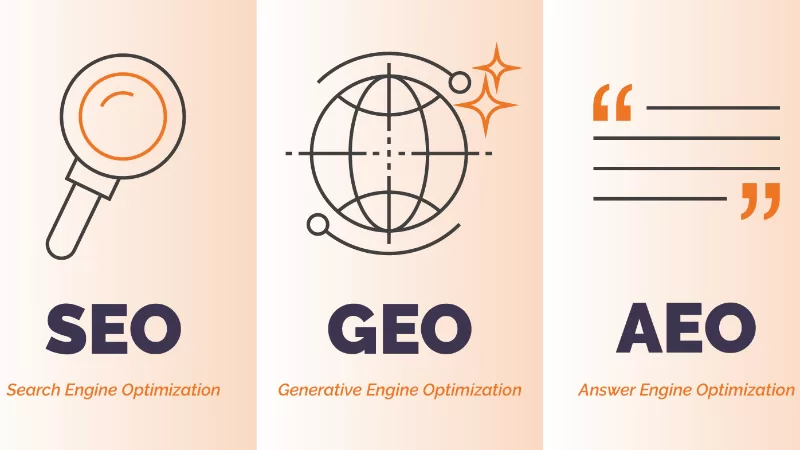
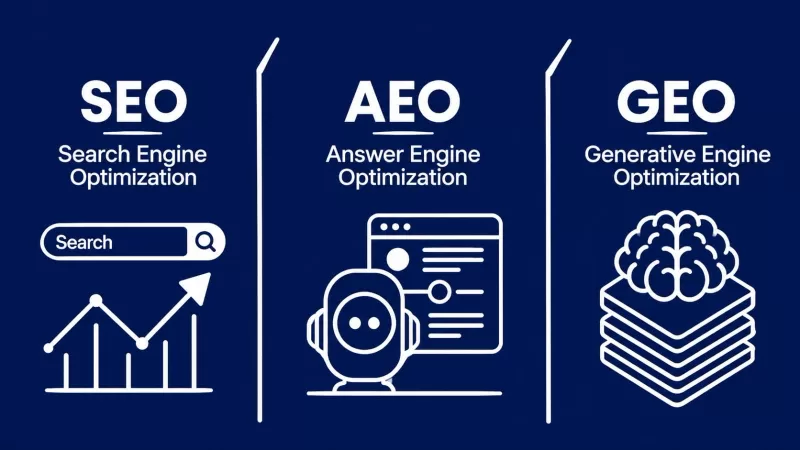
Three terms keep appearing, so here they are in plain words. Answer engine optimization (AEO) is about shaping a page, so that a machine can pick out a ready answer, for example a question as a heading with a short reply right under it. Generative engine optimization (GEO) is about becoming a source that AI-written responses mention or cite. SEO is the umbrella: earning visibility through useful content, a healthy website and a trusted name.
- Target — SEO: Ranking in results. AEO: Being the direct answer. GEO: Being cited in generated text.
- Typical tactic — SEO: Helpful content, links, technical health. AEO: Question headings, short answers. GEO: Brand mentions, original data, reviews.
- Win looks like — SEO: A click. AEO: A featured answer. GEO: A named source.
Are they separate? For Google, mostly not. Google's May 2026 guide says optimizing for its generative AI features is still SEO, because they are rooted in core ranking and quality systems.
It also says you do not need an llms.txt file, content split into chunks, or special markup (Google Search Central, 2026). That claim covers Google only. ChatGPT, Perplexity and others may weigh signals differently.
That is why a beyond-Google strategy needs testing, not assumptions.
What Is Different in Bangladesh? Bangla, Banglish and Facebook
DataReportal counted 82.8 million internet users in Bangladesh in October 2025, about 47% of the population, and 64.0 million social media user identities (Kemp, 2025). Many people search in Bangla, in Banglish typed with English letters, or in English, sometimes in one query.
Social platforms, especially Facebook, are where many Bangladeshi customers discover and judge businesses.
This creates a local opportunity. Generic English answers about any topic are plentiful, but a clear answer in plain Bangla or Banglish with real BDT prices, areas and customer proof is rare.
Also check what AI tools actually show in Bangladesh: Google's Bengali AI Mode announcement was India-focused, so availability and quality here should be tested, not assumed.
My Beyond Google Test: One Question, Three Platforms
Reading about AI search is one thing, so I tested it. On 14 November 2026, between 3:41 and 3:44 PM Bangladesh time, I asked the same question on my phone. I used Google, ChatGPT and Perplexity.
I typed it the way many Bangladeshis really type: "Dhaka-te beginner-der jonno best digital marketing course ki?" Then I scrolled through each answer, took screenshots and checked the claims I could.
Google: a framework, many videos and a local map

Google opened with an AI Overview written in Banglish to match my question. It did not name one best course. Instead, it said the answer depends on budget, learning style (offline or online) and goal (freelancing, a local job or your own business).
It promised a list of "Top Offline & Hybrid Institutes (Dhaka)" behind a Show more button. Below that came YouTube and Facebook videos, many company pages and a government portal.
Then came a map with three local institutes: Webcoder-IT Institute (5.0 stars, 929 reviews), Projuktir Pathshala Institute (4.9, 189) and Advance IT Center (4.6, 150).
Two details stood out. Google crossed out my Banglish words, such as "der jonno ki", as missing from several results, so it matched mostly on the English part of my question.
And the text under the first video result, published in May 2024, listed IIM Skills, DMI, Simplilearn, Great Learning and MICA as top institutes in Bangladesh. These are Indian or international brands, not Dhaka institutes.
ChatGPT: a confident shortlist that knew me

ChatGPT worked for 15 seconds and answered in Bangla. It named three institutes for 2026: Creative IT Institute (labelled "Best overall for beginners"), BITM and Bongiyo.
Each had a photo, course length, a fee (৳30,000 for Creative IT and ৳42,900 for BITM), an address and links. It added a 12-topic checklist for a beginner course and a map with ratings.
What surprised me most came near the end. I asked ChatGPT about digital marketing courses, and it told me I do not need to take the same course twice. It knew about my digital marketing course at Creative IT Institute.
Maybe I had mentioned it some time ago, but I did not expect it to remember. It then asked whether I was searching for myself or for another beginner and offered to build a shortlist.
Perplexity: a different winner and a long list of sources

Perplexity also answered in Bangla, but with a very different top pick. It said to start with Ostad's free "Fundamentals of Digital Marketing" course (two weeks, six live classes).
Then move to Ostad's "AI Driven Full Stack Digital Marketing 2026". It added a comparison table, a five-point checklist for choosing a course, and 10 sources. The table had Ostad, eShikhon and one row grouping Creative IT, Shikhbe Shobai and Bohubrihi.
The sources named inside the answer were Ostad, eShikhon and one personal blog.
Side by side: one question, three different winners
- Answer format — Google: AI Overview in Banglish, then videos, links and a map. ChatGPT: One long Bangla answer with cards, photos and a map. Perplexity: One Bangla answer with a table and 10 sources.
- Top pick — Google: No single pick. the map led with Webcoder-IT Institute. ChatGPT: Creative IT Institute, then BITM and Bongiyo. Perplexity: Ostad's free course, then Ostad's full course.
- Sources shown — Google: Company sites, videos, a government portal. ChatGPT: Institute websites and a map. Perplexity: Ostad, eShikhon and a personal blog.
- Did I need to click? — Google: Yes, to compare options. ChatGPT: Not for a shortlist. yes to confirm fees. Perplexity: Not for a shortlist. I opened the cited pages.
- Bangladesh facts — Google: Old video. non-Dhaka brands in one description. ChatGPT: Fees given, not confirmed by me. Perplexity: Free-course details matched Ostad's page.
Did the facts hold up?

I opened the pages Perplexity relied on. Ostad's page confirmed the free two-week course with six live classes. Its AI Driven course page showed a 4.7 rating from 218 reviews, a batch starting on 29 November and a discounted price of ৳8,320 (down from ৳12,800) with a Friday promo code. eShikhon's AI-driven course page listed 46 classes at ৳5,490.
I did not check ChatGPT's fee figures against the institutes' own pages, so I treat them as unconfirmed.
One caution: the page backing Perplexity's top pick is Ostad's own sales page, and that same page says that finishing the free course will not make you a digital marketing expert.
What surprised me
My first thought, after looking at the three answers, was that they were pretty similar. Some were a little better and some a little boring. Looking closer, the top picks were different: Creative IT Institute on ChatGPT, Ostad on Perplexity, and no single winner on Google.
I liked ChatGPT and Perplexity the most. I could find and understand what I needed without any hassle, and the answers suited my situation.
The biggest surprise was ChatGPT's memory. It warned me not to take the same course twice, which means it already knew what I was learning. That made me realize that the information we give these tools stays with them.
They remember many small details and can work out a lot about us and our behavior. It makes the answers feel personal, and it is also a reason to be careful about what we share.
One more thing I noticed: Perplexity's top recommendation rested mainly on the seller's own pages and one personal blog.
What this means for SEO
First, every door needs its own work, because a top Google position does not guarantee a mention in ChatGPT or Perplexity. Second, reviews and a complete Google Business Profile matter: the Google map and ChatGPT's map both put star ratings and review counts up front.
Third, plain, factual pages are easy to quote. Ostad's pages state duration, number of classes, batch date and price in clear text, and that is the kind of page an AI answer can use.
Finally, because answers can be personal, one-off rank checks tell you less than before, so a trusted brand and steady reviews matter more.
Run the test yourself
You can repeat this in five minutes with one real customer question from your own business. Ask it on all three platforms, ideally on your phone, and score each answer on five points.

Repeat the test every few weeks and keep screenshots, because these answers change fast. If the answers cite forums and videos, your brand needs a presence there. If they name no local sites, a specific, honest page with real BDT prices can fill the gap.
How Do You Adapt Your AI Search SEO? 6 Practical Steps
To keep it concrete, picture a coaching center in Uttara that teaches spoken English. This is an imagined example, not a real case.
- Answer first. Under a heading like "What is the monthly fee for a spoken English course in Uttara?", give the direct answer in two or three sentences, then explain. Readers get what they came for, and machines can lift the answer cleanly.
- Publish proof only you have. The center can show real class photos, fees in BDT, batch timings and student results. A generic AI answer cannot invent these, and Google's guide points to unique, non-commodity content as what matters most.
- Open the right doors technically. Make sure pages are indexed and can show a snippet in Google. For ChatGPT search, consider allowing OAI-SearchBot in robots.txt, and decide separately about GPTBot. Keep pages fast on mobile.
- Be present where AI looks. Keep your Google Business Profile accurate, post useful YouTube videos, stay active on Facebook and collect honest reviews. Join community discussions as a real helpful person, never with fake or paid mentions.
- Write the way people ask. Customers type in Bangla, Banglish and English. Use the real phrases in headings and answers, and avoid stuffing the same keyword again and again.
- Measure and test monthly. In Google Analytics, check referrals from sources such as chatgpt.com and perplexity.ai, add "How did you hear about us?" to order forms, and repeat the Beyond Google Test every few weeks.
What you can skip
For Google's AI features, Google says you do not need llms.txt, chunked content or special AI markup. Spend that time on steps one, two and four.
What Are the Limits and Risks?
- Confident mistakes. AI tools can sound sure and still be wrong, particularly about Bangladesh. Check any number against the provider's own page.
- Credit without clicks. AI answers use publishers' work while sending few visits back, and the trade-off is still debated.
- Platform dependence. Rules change quickly. Do not replace one platform with another; own an email list and a direct audience.
- Thin local evidence. Most studies are recent, short and based on U.S. users, so read every statistic as a snapshot, not a law.
FAQ
Is Google still important for SEO?
Yes. Large studies still show organic search as the biggest traffic source, and AI features inside Google are built on its core Search systems. But it is no longer the only place customers find answers.
What is the difference between SEO, AEO and GEO?
They aim at different results: SEO at rankings, AEO at direct answers and GEO at mentions inside AI responses. The foundation is the same for all three: helpful, original and trustworthy content.
Do I need llms.txt for AI search?
For Google's AI features, Google says no. Other tools may behave differently, so check each platform's own documentation.
What should a beginner do first?
Choose one question your customers really ask. Answer it at the top of a page, add one thing only your business can say, and then run the Beyond Google Test to see what changes.
Conclusion
Nothing here means the old SEO lessons are dead. They simply have to work in more places now. Google remains the biggest door. But ChatGPT, Perplexity, AI summaries and social video are doors too.
Businesses that are clear, original, easy for crawlers to reach and trusted by real people can be found at every one of them. That is the heart of AI search SEO. This week, run the Beyond Google Test on one question from your own business and ask yourself one thing: what do all these answers miss that only I can say?
Image Plan and Alt Text
- beyond-google-featured.png — Featured graphic. Under the H1. Alt text: Graphic of a single search box with the question "best digital marketing course for beginners in Dhaka" branching into four answer sources: Google, ChatGPT, Perplexity and YouTube or Facebook.
- four-doors-framework.png — Four Doors diagram. In the first H2. Alt text: Diagram of the Four Doors to your brand: Google results, Google AI features, AI assistants such as ChatGPT and Perplexity, and social or video search.
- test-google.jpg — My Google screenshots. Under the Google H3. Alt text: Three phone screenshots of Google results for the Banglish question: an AI Overview, a block of videos with company pages, and a map of three local institutes with star ratings.
- test-chatgpt.jpg — My ChatGPT screenshots. Under the ChatGPT H3. Alt text: Three phone screenshots of ChatGPT answering in Bangla with a top three list, fees and addresses, a topic checklist and personal advice.
- test-perplexity.jpg — My Perplexity screenshots. Under the Perplexity H3. Alt text: Three phone screenshots of Perplexity answering in Bangla with a first recommendation, a comparison table and a three-step plan.
- test-verify.jpg — Fact-check screenshots of Ostad's pages. Under the fact-check H3. Alt text: Two phone screenshots of Ostad's course pages showing the free two-week course and the AI Driven course with a rating, batch date and price.
- beyond-google-test-scorecard.png — Scorecard graphic. Under the last H3 of the test. Alt text: Scorecard with five checks for comparing Google, ChatGPT and Perplexity.
References
- Ahrefs. (2026, November). The 50 most-cited websites in Perplexity. https://ahrefs.com/blog/most-cited-domains-perplexity/
- Chapekis, A. (2025, July 22). Google users are less likely to click on links when an AI summary appears in the results. Pew Research Center. https://www.pewresearch.org/short-reads/2025/07/22/google-users-are-less-likely-to-click-on-links-when-an-ai-summary-appears-in-the-results/
- eShikhon. (n.d.). AI-driven digital marketing course [Course page]. Retrieved November 14, 2026, from https://eshikhon.com.bd
- eWeek Staff. (2026, February 27). ChatGPT nears 1 billion weekly users in record growth surge. eWeek. https://www.eweek.com/de/news/chatgpt-hits-900m-weekly-users/
- Google India. (2025, October 8). Supercharging Search for India: New languages in AI Mode and Search Live debuts. Google Blog. https://blog.google/intl/en-in/products/supercharging-search-for-india-new-languages-in-ai-mode-search-live-debuts/
- Google Search Central. (2026, May). Optimizing your website for generative AI features on Google Search. https://developers.google.com/search/docs/fundamentals/ai-optimization-guide
- Google Search Central. (n.d.). AI features and your website. https://developers.google.com/search/docs/appearance/ai-features
- Kemp, S. (2025, November 8). Digital 2026: Bangladesh. DataReportal. https://datareportal.com/reports/digital-2026-bangladesh
- OpenAI. (n.d.). Overview of OpenAI crawlers. https://developers.openai.com/api/docs/bots
- Ostad. (n.d.). Fundamentals of Digital Marketing and AI Driven Full Stack Digital Marketing 2026 [Course pages]. Retrieved November 14, 2026, from https://ostad.app
- SE Ranking. (2026). Analysis of top AI search engines: Who is catching up to ChatGPT? https://seranking.com/blog/ai-traffic-research-study/
- Shisir, B. F. I. (2026, November 14). Personal test: Google Search, ChatGPT and Perplexity answering one question [Phone screenshots]. Captured at google.com, chatgpt.com and perplexity.ai. https://perplexity.ai
- Southern, M. G. (2025, September 29). Impact of AI Overviews: How publishers need to adapt. Search Engine Journal. https://searchenginejournal.com/impact-of-ai-overviews-how-publishers-need-to-adapt/556843
- Southern, M. G. (2026a, February 25). Gen Z preference for TikTok over Google drops 50%, data shows. Search Engine Journal. https://www.searchenginejournal.com/gen-z-preference-for-tiktok-over-google-drops-50-data-shows/568267/
- Southern, M. G. (2026b, April 27). AI Overviews cut organic clicks 38%, field study finds. Search Engine Journal. https://www.searchenginejournal.com/ai-overviews-cut-organic-clicks-38-field-study-finds/573145/
AI / Third-Party Disclosure
I used Claude (Anthropic) to help research sources, plan the structure and draft and refine the wording. The three graphics (featured image, Four Doors diagram and scorecard) were produced with AI-assisted code.
The Beyond Google Test was run by me on 14 November 2026, the personal reflections in the test section come from my own notes (Claude helped polish the English), and the screenshots are my own captures of Google, ChatGPT, Perplexity and the course providers' public pages.
Grammar was checked with the open-source LanguageTool, and the text was compared with the competition's sample article for overlap. I am responsible for the accuracy, originality and references of this article.
Written by
Bokthiar Faimul Islam Shisir
Comments (0)
No comments yet — be the first to share your thoughts.