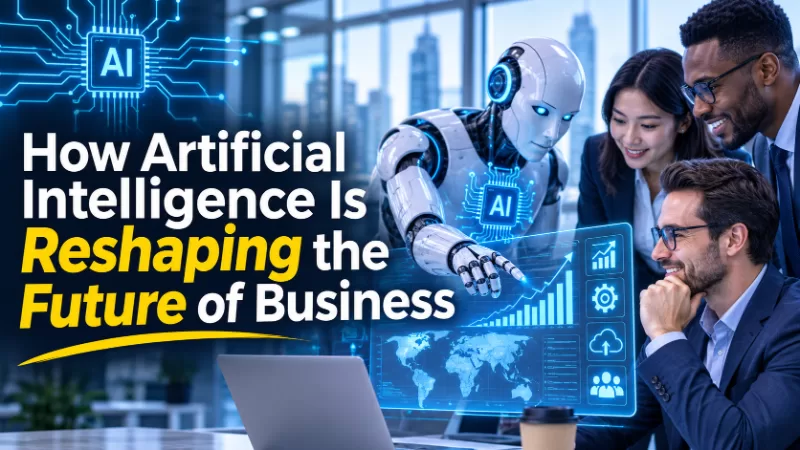
A decade ago, artificial intelligence sounded like science fiction. Today it drafts emails, answers customer questions, predicts demand and flags fraud, often in seconds. AI in business is no longer a luxury for tech giants. It is becoming a basic tool for companies of every size. Understanding how it is changing the way we work is now essential for students, professionals and entrepreneurs alike.

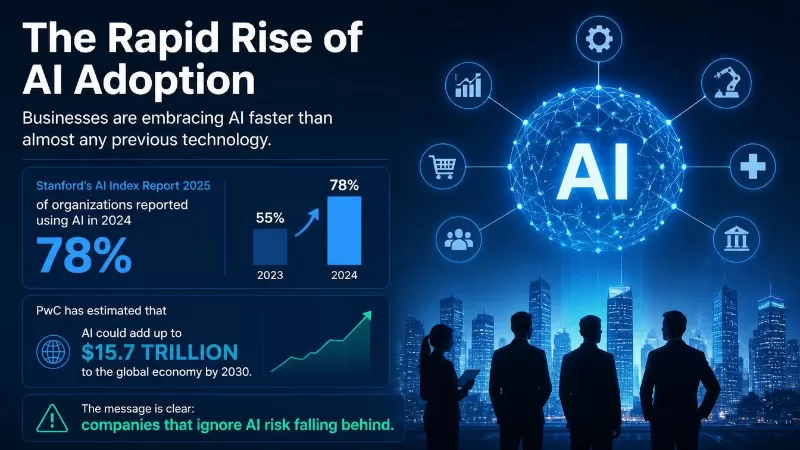
The Rapid Rise of AI Adoption
Businesses are embracing AI faster than almost any previous technology. Stanford’s AI Index Report 2025 found that 78% of organizations reported using AI in 2024, up from 55% the year before. PwC has estimated that AI could add up to $15.7 trillion to the global economy by 2030. The message is clear: companies that ignore AI risk falling behind.

Key Ways AI Is Transforming Business
Smarter Customer Service
AI chatbots and virtual assistants answer common questions around the clock, cutting wait times and freeing human agents for complex problems. Natural language tools can also analyze customer feedback and detect frustration early, helping companies respond before a customer leaves.

Data-Driven Marketing and Sales
Marketers use AI to segment audiences, personalize offers and predict which leads are most likely to buy. Generative AI can produce first drafts of ad copy, product descriptions and social posts, shortening campaign timelines. McKinsey estimated that generative AI could add between $2.6 trillion and $4.4 trillion in value annually across use cases, with marketing and sales among the biggest beneficiaries.

Efficient Operations and Supply Chains
Business automation powered by AI handles repetitive tasks such as invoice processing, data entry and scheduling. In logistics, machine learning forecasts demand, optimizes delivery routes and predicts equipment failures before they cause costly downtime. In finance, algorithms monitor transactions in real time to detect fraud.
Better Decisions Through Analytics
Leaders once relied on monthly reports and intuition. AI analyses vast datasets instantly and surfaces patterns humans might miss, from changing buying habits to emerging risks. This lets managers make faster, evidence-based decisions.
AI and the Future of Work
The biggest question is what AI means for jobs. The World Economic Forum’s Future of Jobs Report 2025 projects that by 2030, about 170 million new roles will be created while 92 million are displaced, a net gain of 78 million jobs. Work will not disappear, but it will change. Routine tasks are the most exposed, while skills such as analytical thinking, creativity, adaptability and AI literacy are growing in demand.

Opportunities for Small Businesses
AI is no longer expensive or exclusive. Affordable cloud-based tools let small businesses and startups automate bookkeeping, run targeted campaigns and offer 24/7 support without large teams. This helps smaller players compete with bigger rivals.
Challenges Businesses Must Address
AI also brings real risks. Models can reflect bias in their training data, and they sometimes generate confident but incorrect information. Customer data must be protected, and companies need transparent policies on how AI is used. Employees also need training so that AI supports them rather than leaves them behind.
How to Adopt AI Responsibly
1. Start with a clear problem. Choose one task, such as customer support or reporting, instead of adopting AI everywhere.
2. Keep humans in the loop. Review AI outputs, especially for important decisions.
3. Protect data. Follow privacy laws and avoid feeding sensitive information into unsecured tools.
4. Invest in people. Train teams to work alongside AI.
Conclusion
Artificial intelligence is not replacing business; it is redefining how business works. Companies that use AI thoughtfully can serve customers better, cut costs and make smarter decisions, while those that ignore it may struggle to keep up. The winners will pair powerful technology with human judgment, ethics and creativity. Whether you are a student, an employee or a founder, now is the time to learn how AI works and how it can create value.
References
· Stanford HAI. (2025). The AI Index Report 2025. https://hai.stanford.edu/ai-index/2025-ai-index-report
· PwC. (2017). Sizing the Prize: What’s the Real Value of AI for Your Business? https://www.pwc.com/gx/en/issues/artificial-intelligence/publications/artificial-intelligence-study.html
· McKinsey & Company. (2023). The Economic Potential of Generative AI: The Next Productivity Frontier. https://www.mckinsey.com/capabilities/mckinsey-digital/our-insights/the-economic-potential-of-generative-ai-the-next-productivity-frontier
· World Economic Forum. (2025). The Future of Jobs Report 2025. https://www.weforum.org/publications/the-future-of-jobs-report-2025/

Written by
Abdur Rahman
Comments (0)
No comments yet — be the first to share your thoughts.